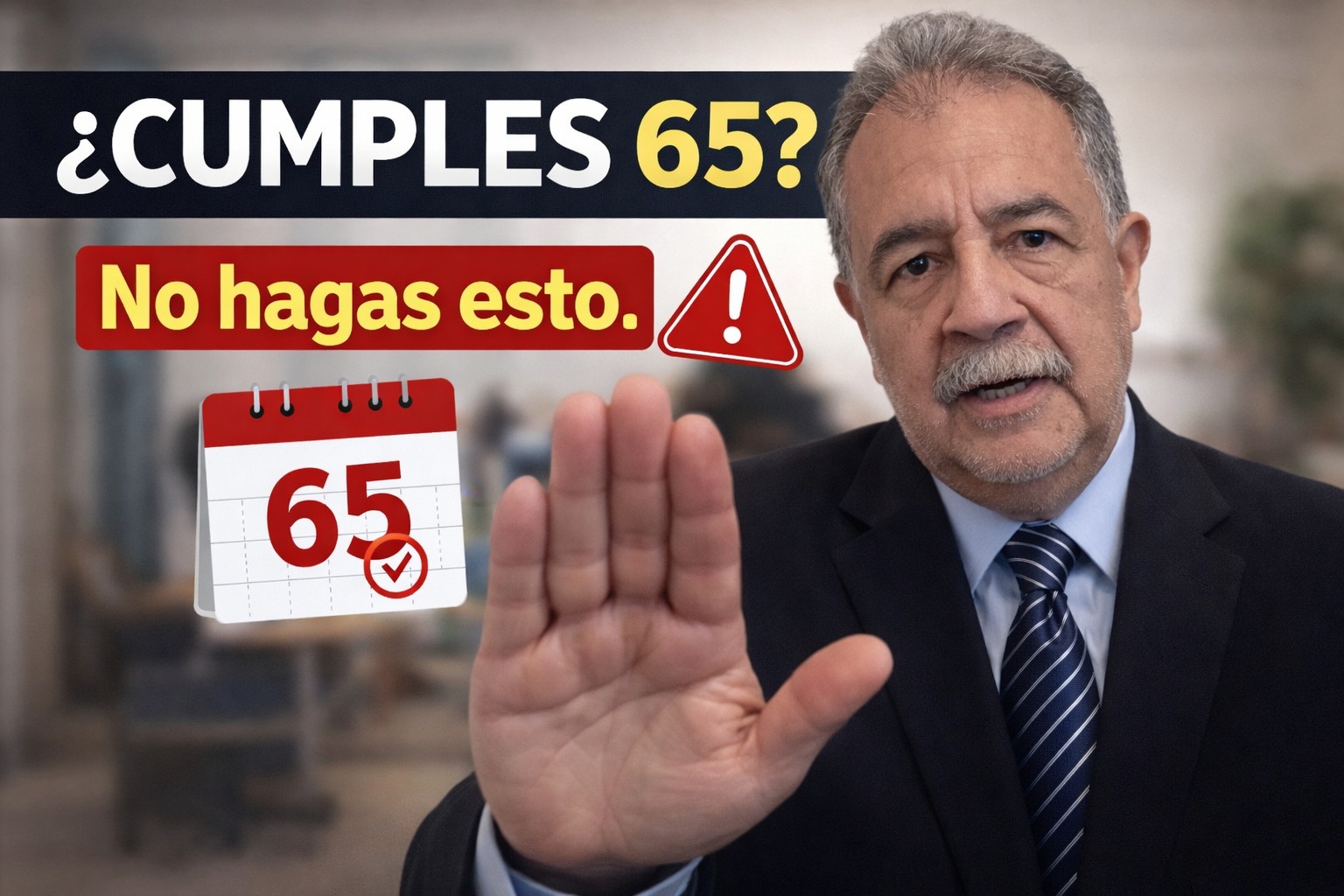
Mario Cruz Pérez, Licensed Independent Insurance Agent, licensed in 16 states (NPN 1840117). 13+ years helping the Hispanic community with Medicare.
There’s a myth that costs many Hispanic families money every year: believing that Medicare “just arrives” when you turn 65. The truth is that, for most people, Medicare at 65 is not automatic, and if you miss your enrollment window, the penalty can follow you for life. If you or a family member is getting close to that age, this is the review you need before doing anything.
In this article I explain, in plain language, when Medicare is automatic and when it isn’t, what the 7-month enrollment window is, how much Part B costs in 2026, what happens if you keep working, and what to do if you already missed the deadline. You’ll come away knowing exactly what to check and in what order.
A note from the start: the amounts and rules I mention are the ones in effect for 2026 and may change every year, and your specific situation depends on your work history and on whether you receive Social Security. To review your case, it’s best to look at it one on one. At the end I’ll show you how to contact me. Below is the video version of this guide (in Spanish).
Is Medicare Automatic When You Turn 65?
Only in one case: if you are already receiving your Social Security check before 65, you are automatically enrolled in Part A and Part B, and your card arrives in the mail. If you are not receiving Social Security yet (because you are still working or decided to wait to collect more later), then it’s up to you to enroll. Assuming it will just arrive is the mistake that starts almost every problem.
The 7-Month Window (Initial Enrollment Period)
Your Initial Enrollment Period lasts 7 months: the 3 months before your 65th birthday, the month of your birthday, and the 3 months after. Enrolling early in that window avoids delays in when your coverage starts. If you let it pass without other valid coverage, you enter penalty territory.
Part A: The 40 Credits That Make It Free
Part A is hospital coverage. To get it with no monthly premium, you need to have worked and paid taxes into the system for about 40 credits (around 10 years of work). In 2026, each credit is earned with a certain amount of income (reference: $1,890 per credit). If you don’t reach 40 credits, you can still get Part A, but you pay a monthly premium. That’s why it’s a good idea to review your work history before you enroll.
Part B: What It Costs in 2026 and the Lifetime Penalty
Part B (doctors and outpatient services) does have a cost: in 2026 the standard premium is $202.90 per month for most people, and it is usually deducted from your Social Security check. Some people with higher incomes pay more. Here is the critical part: if you don’t take Part B when you’re supposed to and you don’t have other valid coverage, when you enroll later you pay a penalty of 10% for every 12 months of delay, for life. It’s not a one-time penalty.
Still Working at 65?
If you are still working and your company has 20 or more employees, you may be able to delay Part B without a penalty while you have employer coverage, and then enroll through a Special Enrollment Period when you leave that job. But the rules depend on the size of the company and the type of coverage. It’s exactly the kind of detail worth confirming case by case before you decide.
What Happens If You Already Missed the Deadline?
If you let your 7-month window pass and you didn’t have other valid coverage, you have to wait for the General Enrollment Period, from January to March each year. The problem is that while you wait, the Part B penalty is already adding up. So if you think you missed it, the best thing is to review your situation as soon as possible.
Your First Step: Check ssa.gov
Before you call or apply, open your “my Social Security” account at ssa.gov. There you can see your work credits and your status. Knowing what you have avoids surprises, like finding out too late that your Part A wasn’t free. With that information in hand, decisions become much simpler.
Let’s Clear Up a Common Myth
“Medicare is free” is false: Part B costs $202.90 in 2026. “They enroll me automatically” is only true if you are already retired and collecting Social Security. Separating myth from reality is what saves you money and headaches when you turn 65.
FAQ (Frequently Asked Questions)
Does Medicare start automatically when I turn 65?
Only if you are already receiving Social Security before 65. If not, you have to enroll yourself during your 7-month window.
When is my enrollment window?
The 3 months before your 65th birthday, the month of your birthday, and the 3 months after: 7 months in total.
How much does Part B cost in 2026?
For most people, $202.90 per month; people with higher incomes pay more.
Is Part A free for everyone?
It is premium-free if you worked about 10 years (around 40 credits). If not, it has a monthly premium.
Can I delay Medicare if I’m still working?
Sometimes, yes, if your employer has 20 or more employees and you keep that coverage. It’s best to confirm it based on your case.
Getting close to 65, or helping your parents with this? I’ll review your case at no cost and with no pressure. If the answer is “wait a little longer,” I’ll tell you that too.
Office hours: Monday to Friday, 9:00 AM – 6:00 PM (Central Time)
Mario Cruz, licensed agent in 16 states. This information is educational and is based on information from qualified carriers the agency has contracts with. We do not offer every plan available in your area. For a personalized review of your case, call me at 832-789-3845 or message me on WhatsApp at 346-574-6912. For all of your options, call 1-800-MEDICARE (TTY 711) or visit Medicare.gov.